Welcome to America's Optimistic futurist
Proven ways to improve kids' learning
without messing with teachers.

Need a Partner? Try the U.S. Department of Energy's Teaming Partner List.
Energy costs too high at your school? Learn about DOE's Qualified List of Energy Service Co's.
NEW Subscriber? Find Past Newsletters, below!
Newsletter of the Week
Unless you understand the difference
between “Climate Change” and “Global Warming,”
we are all at risk.
A massive winter storm was headed our way last week.
As it hit our communities and people were being warned to expect cold, ice, and power outages, you may have heard some friends and neighbors say something like “Ha! See what a bunch of nonsense all those claims of global warming were!” Others might have disagreed, saying that climate change is happening. Because each party used one of two different terms (“global warming” and “climate change”), they were talking past each other—though they may not have known it. And your children’s futures are at serious risk.
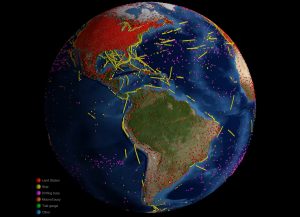
Global warming is measured by 32,000 weather stations around the world, including in the ocean. Starting in the 1950’s, every hour or so, scientists from around the world transfer those temperatures to a big database and calculate the average. Since the 1950’s, the average temperature of the entire earth has risen between about one and two degrees. That is all. No big deal, right?
Analyzing Surface Temperature Land stations (red) and ships and buoys (yellow). NASA Goddard's Scientific Visualization Studio
Well, no. The educational challenge is that global warming is an average. Think of your daughter putting one hand in your icemaker, and the other hand on your hot stove. Both hands would be in pain – but her nose (the average) would be fine! That is why people who are trying to protect the next generation do not refer to global warming. One or two degrees does not express the magnitude of the harm being done.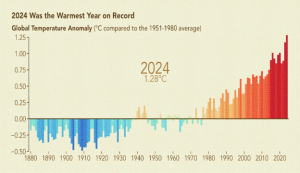
Global Warming Average global surface temperatures since 1880. Temperatures have risen steadily for nearly 150 years.
Earth Observatory/ Michala Garrison
Climate change is measured by variations in temperatures at each of the 32,000 weather stations, referring to specific parts of the world that have become global icemakers and stove burners. In 2024, many geographic areas, such as Phoenix and Las Vegas, were on fire, experiencing hundreds of heat-related deaths. Even Antarctica set heat records! At the same time, Finland and Sweden set new cold records, with temperatures falling 104 degrees below freezing and death rates rising due to cold. Global warming fails to identify and appreciate these tragedies.
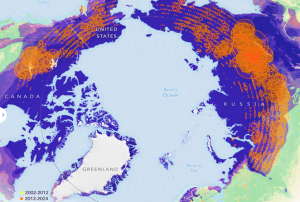
Climate Change Fires on ice in the Arctic, 2012 to 2025 (orange).
NASA Earth Observatory/Michala Garrison
While climate change is causing damage, the Trump administration is preventing parents and kids from learning about it.
For example, an entire website on “Climate and Sustainability” hosted by the U.S. Department of Transportation has now vanished, with the department’s new leadership also ordering the elimination of any policy positions, directives or funding “which reference or relate in any way to climate change, or ‘greenhouse gas’ [sic] emissions.”
And in early April 2025, the educational government website Climate.gov made it more difficult to educate our children by removing sections used by teachers called “Resources,” “Multimedia” and “Interactive Tools.”
The Trump administration also says it intends to dismantle the National Center for Atmospheric Research in Colorado, after firing 400 scientists who were studying where and when climate change’s impact will occur.
Even further, the administration also terminated 7,800 federal grants which were created specifically to study a range of issues, including these:
- how to develop new food crops that will grow in hotter weather or salt water,
- removing climate changing gases from the atmosphere,
- identifying areas most likely to have forest fires,
- how to produce electricity cheaply from non-greenhouse gas producing technology, and
- locally implementable steps that individual homeowners can take to lower their greenhouse gas production.
Last week’s storm was made much stronger by climate change, which creates warmer temperatures in the Arctic ocean, causes more evaporation that floats up to meet very cold air, and contributes to more rain and snow and much higher wind speed.
This storm is an example of what is to come - and our kids are at risk.
According to polls conducted by Yale University, around 75% of adult Americans think climate change is happening, while 10% are not sure. Fifteen percent still think it is not, despite increases in hail damage to home roofs, the cost of home insurance, abandoned beach houses, and cancelled airplane flights. Meanwhile, our food production is dropping.
The current administration is trying to hide information we badly need made public. We must show courage and integrity, and demand they make the invisible visible.
Learn Free,
Earn a Certificate!
Developing Climate Change Lessons
In this self-paced course, teachers learn how to develop K-12 inquiry-based climate lesson plans for all subjects. Six lessons (10 modules) provide instructions about how to choose resources, align the lesson plan to standards, and create accompanying materials. Templates and real lesson examples keep you on track and accelerate your progress toward building your own classroom material.
Check out the guide to find the right PD course for you!
Asthma, Allergies, Infections, Headache, Poor Concentration ...
Illnesses like these may stem from a common source:
Stuffy Air in Your Indoor Environment
If you are like most Americans, 90 percent of your daily activity occurs indoors, where pollutants can be as much as 5 times more concentrated than outdoors. The sources of indoor pollution, such as volatile chemicals, excessive moisture, lead in drinking water, or exposure to radon, can dramatically lower well-being, causing poor school or work performance and absenteeism.
The Pollution Detectives, Inc. lends its experience and equipment to help you manage indoor pollution in your home, school, workplace, or community. Without charge, the 501(c)3 nonprofit provides technical assistance and advanced but simple-to-use air monitors, thermal cameras, lead-in-water meters, refrigerant leak detectors, and radon detectors.
It also offers immediate, practical solutions to fix issues discovered by borrowers--a common occurrence. In 40 percent of over 850 academic locations, for example, indoor air conditions lessened student achievement by at least one letter grade.
If you are interested in borrowing equipment or learning more, please follow a link in our Lending Library ("Highlights ...," below), visit the website, or contact Dr. Francis P. Koster at fkoster@ thepollutiondetectives.org.
"Healthy indoor air isn’t just a lesson from the pandemic—it’s a core flu-season strategy that can help reduce illness, keep classrooms open, and protect children’s health."
Executive Director, Healthy Schools Network
Coordinator, Coalition for Healthier Schools
For background and practical solution, Healthy Schools Network provides a resources page, including the report from our 2024 conference Air Just Air, and the links below to EPA resources designed to help schools improve ventilation and airflow; identify and address moisture, mold, and pollutant sources; maintain HVAC systems effectively; and create healthier learning environments that support attendance and performance.
My books containing other success stories

Written in 2015, this was my first attempt at celebrating successful actions taken by K-12 schools. Although the data is now outdated, the 22 concepts in this book are still valid, and worth a read. The website above will continue to add to that library - look on the right side for more recent role model stories.

We are living in an era when many Americans feel things are out of their control, which causes them frustration, anger, and depression. This book explains the theory and practice of how to influence the direction and growth of your local economy, and regain your power to protect your community and family. First published in 2016, the lessons remain accurate and powerful.
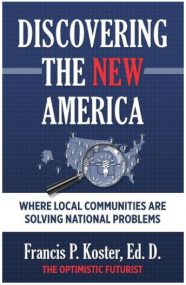
As a country, we are not without solutions. This collection, first published in 2013, takes a country-wide locally solvable view of significant issues which still exist, and in may ways have gotten worse since I first wrote about them. You, can solve these problems by imitating the behavior of the pioneer efforts cited here.
Don’t miss out on new content
Stay up to date with the latest articles, news, or books.
Francis P. Koster Ed.D.
Proven local solutions to national problems.
CONTACT
Copyright © 2023 America's Optimistic Futurist